Farmer-first · Science-supported · Independent of commercial bias
Shrimp health is the route. Farmer wellbeing is the purpose.
Enabling predictable crops.
Shrimp health matters because shrimp farming is a livelihood. When shrimp crops become unpredictable, the damage does not stop at the pond. It reaches the farmer’s finances, confidence, morale, family stability, repayment capacity, and willingness to continue farming.
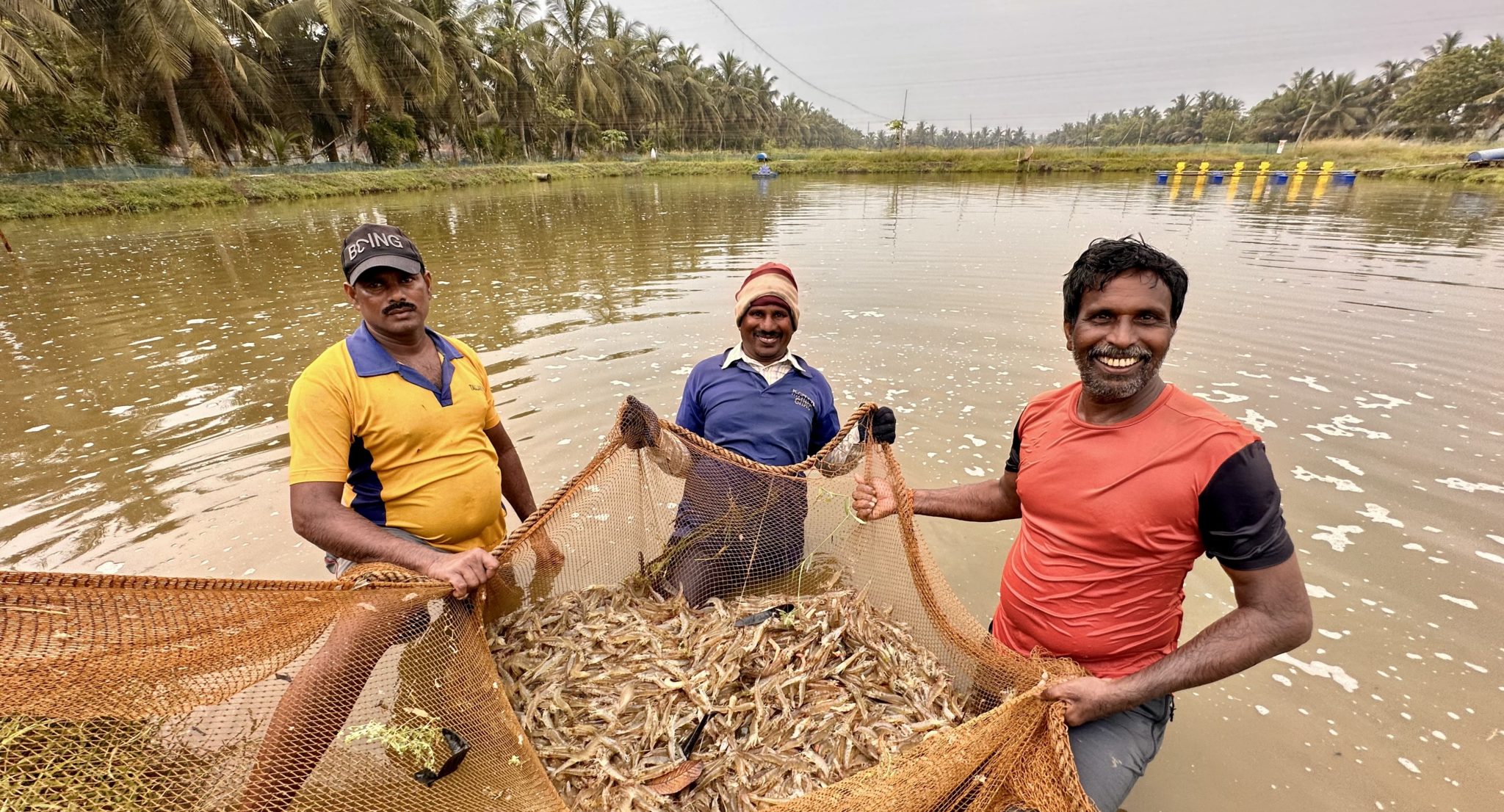
Healthy shrimp. Stronger farmers.
The sharp public tagline.
Shrimp health matters because farmers matter.
The emotional and philosophical anchor. A stable shrimp crop gives the farmer income, confidence, planning ability, repayment strength, and the courage to continue investing in farming. An unstable crop does the opposite.
Science-led shrimp health for farmer resilience and predictable farming outcomes.
The formal institutional description. Together, these give the Foundation a clear identity: scientific, but not cold; farmer-led, but not emotional without structure; collaborative, but not vague.
The central question
How do we make shrimp farming more predictable, more resilient, and less punishing for farmers?
Every program supported by the Shrimp Health Foundation is guided by this question.
About the Foundation
A strengthening mechanism — not a replacement.
The Shrimp Health Foundation is a sector platform created to support the long-term stability of shrimp farming. It connects farmers, scientists, institutions, industry and field intelligence in a structured and transparent manner.
It emerged from CoSDIP — the Collaborative Shrimp Disease Investigation Program — when a successful farmer-led investigation needed a formal institutional base: transparent fund management, the ability to receive CSR and institutional contributions, and room to grow without structural limitations.
PFFI continues to lead and execute CoSDIP on the ground. The Foundation provides funding, governance, compliance and long-term continuity. The Foundation does not work for any individual company. It serves the broader sector.
Read origin and structureHow we work
-
01
Farmers see the problem first
Work begins with real problems faced by farmers, not with abstract institutional priorities.
-
02
Science gives it structure
Field observations are converted into scientific questions. Scientific findings are converted into practical guidance.
-
03
Institutions give it credibility
Scientific partners bring research capacity, laboratory support, and field-linked investigation.
-
04
Industry support gives it strength
Industry partners provide voluntary financial support. The Foundation does not work for any individual company; it serves the broader sector.
-
05
The Foundation gives it continuity
Work that continues beyond one disease event, one crop cycle, one funding round, or one individual initiative.
Flagship program
CoSDIP — India’s first farmer-led shrimp disease investigation initiative.
The Collaborative Shrimp Disease Investigation Program is a national collaborative effort, coordinated by the Prawn Farmers Federation of India. It is built to take a serious disease crisis facing Indian shrimp farmers from field-level distress to scientific clarity, and eventually to practical solutions.
The problem
A recurring pattern of crop instability.
During 2024 and 2025, shrimp farmers across several coastal districts began facing a difficult and recurring pattern of crop instability. Many crops started normally, but farmers increasingly found it difficult to safely hold shrimp beyond approximately 60 to 75 days.
Forced early harvests meant lower size grades, weaker realisation, and compressing losses across the value chain. Patterns described as Running Mortality Syndrome, White Faeces Syndrome and white muscle-related problems were becoming more severe, less predictable, and harder to explain.
The response
A sustained, structured investigation.
CoSDIP is not a one-time survey or a routine research exercise. The sector lacked a structured system that could connect field observations, farm history, pond conditions, sampling, laboratory investigation, and scientific interpretation in one continuous process. CoSDIP was created to fill that gap.
PFFI — the national body representing shrimp farmers across India’s nine coastal farming states, established in 2007 — took ownership of the problem. The conviction was simple: when farmers take the lead, science can be brought into the problem with urgency, structure, and credibility.
Field-to-lab model
Selected ponds are followed from the earliest possible stage of the crop.
The objective is not merely to collect data. It is to generate usable knowledge that helps farmers understand risk, improve predictability, and reduce avoidable losses.
- 01
Soil sampling during pond preparation
- 02
Water sampling before stocking
- 03
Seed sampling immediately after stocking
- 04
Routine farm monitoring through the crop
- 05
Juvenile shrimp sampling as the crop progresses
- 06
Collection of live samples from affected ponds
- 07
Laboratory analysis by scientific partners
- 08
Epidemiological comparison of affected and unaffected ponds
Current phase
Validation is underway. Conclusions will follow the evidence.
CoSDIP is currently in its validation phase. Possible pathogen involvement has been indicated; further validation work is ongoing; firm conclusions will follow completion of the current investigation phase. A case-control study is underway, comparing affected and unaffected ponds. Credibility comes from saying only what can be responsibly said.
0
Farms in the epidemiological survey
0
Zones covered in Nagapattinam district
0
Farmers and stakeholders at the Nagapattinam launch
0
Member multidisciplinary Advisory Board
Institutional structure
A clear origin. A collaborative operating model.
Parent / umbrella body
Prawn Farmers Federation of India
Initiated CoSDIP, leads the program, anchors farmer engagement, and continues to provide field leadership and sectoral direction. Established 2007.
Institutional platform created by PFFI
Shrimp Health Foundation
Supports CoSDIP through funding, governance, transparency, compliance and long-term institutional continuity. Incorporated February 2026 as a Section 8 not-for-profit.
Scientific partner
ICAR–CIBA
Core scientific partner providing investigation leadership and laboratory support. Central Institute of Brackishwater Aquaculture.
Scientific partner
MPEDA–RGCA
Supports laboratory work, field-linked investigation and validation. Rajiv Gandhi Centre for Aquaculture.
International collaborator
University of Arizona
International scientific collaborator providing technical engagement and comparative shrimp health expertise.
Industry supporter network
Shrimp Health Alliance
Industry supporter network providing voluntary financial support for the farmer-led investigation.
Recognition
National and international attention, earned in the field.
-
Nov 2025
Presented at World Aquaculture Society — WAS India 2025, Hyderabad.
-
Mar 2026
Presented at SyAqua Global Shrimp Summit, Penang, Malaysia.
-
Apr 2026
Foundation launch covered by The Fish Site, Aquaculture Asia Pacific, and Benison Media.
-
Feature
Featured in Aquaculture Asia Pacific, recognising the farmer-led and collaborative nature of the program.
Support SHF
Transparent support for a farmer-led scientific program.
The Foundation is designed to receive voluntary contributions and grants, including CSR funding, and to ensure transparent utilisation of funds. No invoicing or commercial billing is undertaken — contributions are support towards sector development initiatives.
Independence from commercial bias
Accountability in fund management
Long-term institutional continuity
Contact
Pondicherry, India
The Shrimp Health Foundation is incorporated and operates out of Pondicherry, where the General Secretary is based. PFFI is headquartered in Hyderabad, Telangana.
Shrimp Health Foundation
Section 8 not-for-profit company
Prawn Farmers Federation of India
Hyderabad, Telangana
February 2026